
Learning that you need multiple dental treatments can feel overwhelming.
You may have a filling that needs attention, a damaged tooth, gum problems, missing teeth, or older dental work that has started causing concerns. When several issues are discovered at once, it is natural to wonder what should be treated first and whether everything needs to happen right away.
There is no single order that works for every patient.
A dentist first needs to understand the health of your entire mouth, including your teeth, gums, supporting structures, bite, existing dental work, symptoms, and long-term goals. From there, treatment can be organized according to what is most urgent, what may help preserve your oral health, and what makes sense for your individual situation.
The goal is not to complete as many procedures as possible. It is to create a logical treatment sequence that you understand and can work through one step at a time.
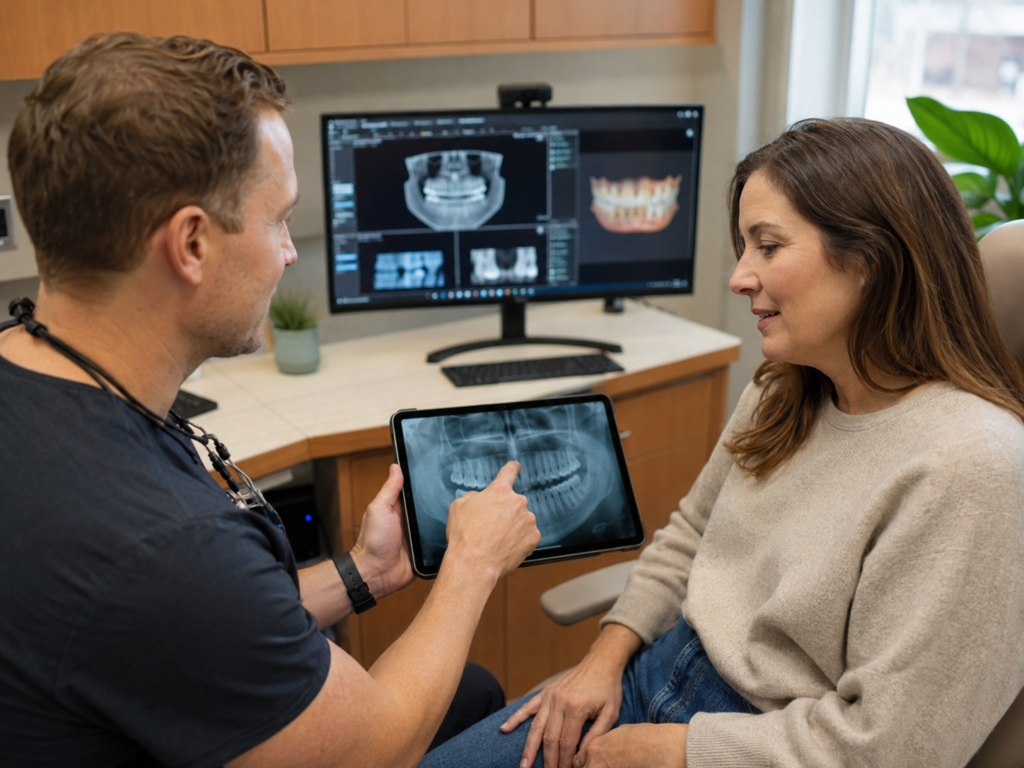
Start With a Complete Dental Evaluation
Before deciding what should be treated first, your dentist needs a clear picture of what is happening throughout your mouth.
A comprehensive dental exam may include evaluating:
- Areas of decay
- Cracked or damaged teeth
- Existing fillings, crowns, bridges, or dentures
- Gum health
- Missing teeth
- How your teeth come together when you bite
- Areas causing pain or sensitivity
Dental X-rays or other diagnostic information may also be used when appropriate.
This broader evaluation matters because dental concerns can influence one another.
For example, replacing a missing tooth may eventually be part of the plan, but untreated gum disease could affect how that treatment is approached. A damaged tooth may need further evaluation before your dentist can determine whether it can be restored.
Your symptoms, medical and dental history, priorities, and treatment goals also matter.
Once the overall picture is clear, the dentist can organize care into logical priorities rather than treating each tooth or concern as a separate problem.
Address Urgent Problems and Gum Health First
When several areas need treatment, active problems that could have a greater immediate effect on your oral health may receive higher priority.
These might include:
- Dental infection
- Significant tooth damage
- Severe or worsening symptoms
- Active decay
- Periodontal disease requiring treatment
The exact recommendation depends on the findings.
For example, root canal therapy may be considered when the tissue inside a tooth is infected or significantly damaged and the tooth can appropriately be restored.
Gum health can also influence the broader treatment plan.
Periodontal disease affects the tissues supporting the teeth. When significant gum concerns are present, your dentist may recommend periodontal treatment such as scaling and root planing before moving forward with certain restorative procedures.
That does not mean every other type of care must stop until gum health is ideal. Treatment may happen in a coordinated sequence based on urgency and clinical need.
The goal is to establish a healthier, more stable foundation for the next stages of care.
Decide Which Teeth Can Be Restored
Once urgent concerns are identified, your dentist can evaluate which damaged teeth may be preserved with restorative treatment when clinically appropriate.
A tooth with decay or structural damage does not automatically need to be removed.
Depending on its condition, treatment might involve:
- A composite filling
- A dental crown
- Root canal therapy followed by an appropriate restoration
- Another restorative approach
The decision depends on factors such as:
- How much healthy tooth structure remains
- Whether infection is present
- The condition of the supporting tissues
- How the tooth functions within the bite
- Whether the tooth can be restored appropriately
Conservative care means preserving healthy natural tooth structure when it makes clinical sense, not trying to keep every tooth regardless of its condition.
In some situations, extraction may still be the appropriate option when a tooth cannot be predictably restored or retained.
The question is not simply whether a procedure can be performed. It is how treating that tooth fits into the health and function of the rest of the mouth.
Restore Function and Plan for Missing Teeth
Once active disease and damaged teeth have been addressed, the treatment plan may turn toward restoring chewing function and replacing missing teeth when appropriate.
Missing teeth can affect how the remaining teeth work together, but there is no single replacement option for every patient.
Depending on the situation, options may include bridges, dentures, or dental implants.
Your dentist may consider:
- Which teeth are missing
- The condition of neighboring teeth
- Gum and bone health
- Bite relationships
- Existing dental work
- Functional needs
- Treatment goals
The sequence matters because one treatment can sometimes affect another.
For example, the condition of the gums or remaining teeth may need to be addressed before planning a long-term tooth replacement.
Restoring function should therefore be part of the overall treatment plan rather than a separate decision made in isolation.
Treatment Can Often Be Completed in Stages
Needing several procedures does not necessarily mean everything has to be completed at once.
Many treatment plans can be organized into phases.
A possible sequence might involve:
- Addressing urgent problems or infection
- Treating active periodontal concerns
- Repairing or stabilizing damaged teeth
- Restoring chewing function
- Replacing missing teeth when appropriate
- Addressing other long-term goals
That is only an example. The actual order depends on the patient.
A phased approach may make a complex plan easier to understand and gives the dentist an opportunity to evaluate oral health as treatment progresses.
Treatment priorities can also change.
If a tooth develops new symptoms, the condition of the gums changes, or additional information becomes available, your dentist may recommend adjusting the original sequence.
A treatment plan should provide direction without becoming a rigid checklist.
When Full-Mouth Rehabilitation May Be Considered
Some patients have more widespread or interconnected dental concerns involving multiple teeth, missing teeth, the bite, worn restorations, gum health, or several areas of the mouth.
In these situations, full-mouth rehabilitation may sometimes provide a framework for coordinating treatment.
Full-mouth rehabilitation is not one procedure.
It is a personalized treatment approach that may combine different types of restorative or other dental care based on the patient’s individual needs.
The purpose is to consider how the teeth, gums, bite, and restorations work together instead of approaching every concern separately.
Not everyone who needs several dental treatments requires full-mouth rehabilitation. Many patients may be appropriately treated with a more limited phased plan.
A comprehensive evaluation helps determine how extensive the treatment plan needs to be.
Questions to Ask About Your Treatment Plan
When several dental concerns are identified, understanding the reasoning behind the plan can make the process feel more manageable.
Consider asking:
- Which problems need attention first?
- Are any of my dental concerns urgent?
- Which teeth may be restored?
- Can my treatment be completed in stages?
- How will each step affect treatment I may need later?
There may be more than one reasonable way to approach some dental concerns.
Your dentist should explain the available options, why a particular sequence is recommended, and how each stage supports the larger treatment plan.
Patient participation is an important part of comprehensive care.
Build Your Dental Plan One Step at a Time
When you need multiple dental treatments, not every concern has the same urgency and everything does not necessarily need to happen immediately.
The first step is understanding the condition of your entire mouth and identifying what deserves priority.
Treatment may begin with infection, damaged teeth, or periodontal disease before moving toward restoring function, replacing missing teeth, or addressing other long-term goals.
Wilson Family Dental emphasizes comprehensive evaluation, patient education, and individualized treatment planning so patients can understand what needs attention and why.
If you have several dental concerns and are unsure where to begin, schedule a comprehensive new patient exam to evaluate your needs and develop a clearer treatment plan.